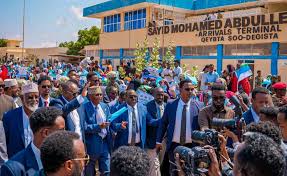
Kismayo and the End of Illusions: A Presidency That Ran Out of Time
The opposition meeting in Kismayo is no longer just another gathering of familiar faces. It feels different, heavier. Not because everyone suddenly agrees, but because many of us now accept a hard truth we spent too long avoiding: Hassan Sheikh Mohamud’s government has failed to deliver on the very promises it asked Somalis to be patient for.
The meeting, initially scheduled for 20–22 December and now nearing its conclusion, has brought together most of the country’s serious political actors. Former prime ministers Mohamed Hussein Roble, Hassan Ali Khaire, and Abdi Shirdoon are present. Sheikh Sharif Sheikh Ahmed arrived later, as expected. And importantly, Puntland President Said Abdullahi Deni’s participation means this is no longer just an opposition discussion - two federal member states are now directly represented in the room, alongside Jubaland.
Farmaajo is not there. That debate is settled. What remains unsettled, and far more important, is what we do next.
We Gave Him Time. It Was Wasted.
For nearly two years, many of us held back criticism. We were told the government needed space to fight Al-Shabaab. Fair enough. Somalia has been here before - security first, politics later.
But honesty matters. The war did not deliver what was promised.
Al-Shabaab is still very much alive. It continues to strike at will, adapt tactically, and undermine public confidence. After all the mobilization, the rhetoric, the international support, and the sacrifices made by ordinary Somalis, we are still told to wait.
At some point, waiting becomes self-deception.
Worse still, the security campaign was used to justify centralization, silence critics, and weaken institutions. What we were promised was a stronger state. What we got instead was fragile security gains sitting on top of hollowed-out governance.
Corruption Became Normalized, Not Confronted
While the government spoke the language of reform, corruption deepened. Land grabbing in Mogadishu accelerated. Public land quietly changed hands. Courts lost independence. Accountability became selective.
This is not background noise. It is the core of the problem.
A government fighting an existential war does not get a free pass to loot the future. Yet that is how it increasingly feels to many Somalis: a presidency that used urgency as cover for enrichment and impunity.
The result is predictable. Trust collapsed. Political relationships deteriorated. Institutions weakened further.
Kismayo’s Real Question
Inside the Kismayo meeting, the real debate is not about personalities. It is about strategy.
Some argue we should still sit with Hassan Sheikh Mohamud and apply pressure directly. Others believe dialogue has already been abused and that meaningful pressure must come through political alignment, federal leverage, and international engagement.
What unites both sides is something new: no one believes the status quo can continue.
With Puntland and Jubaland both involved, this is no longer a Mogadishu-centered conversation. It reflects a growing realization that the federal center has failed to lead and failed to reform.
Time Has Run Out
Hassan Sheikh Mohamud’s term expires in May 2026. With less than six months remaining, the idea that this administration can still turn things around is no longer serious.
The legacy is already forming. Somalia today is not more secure. It is not better governed. It is not more united. In many ways, it is worse off than when this presidency began.
The Kismayo meeting will not magically fix that. But it matters because it signals a shift: we are finally willing to say, out loud, that this presidency did not deliver - and that pretending otherwise only deepens the damage.
This moment is not about removing a president. It is about whether Somalia’s political class can still act responsibly before the transition arrives. Whether we can stabilize the country, protect institutions, and avoid sliding further into crisis.
Kismayo is not a solution. But it is an overdue admission. And sometimes, that is where real political change begins.